Description of the new TGS cargo box built on 12/09/14
Aiming at lightning the MAN TGS competition truck from Team Oleoban, therefore making it easier to tread on sand, giving more competitiveness to the team, a new cargo box was built. It was designed by Engineer João Sabino and built at Carroçarias Sabino.
Keeping an innovative design, it was planned according to the following vectors for improvement:
- Weight reduction;
- Strengthening the chassis;
- Functionality;
- Aerodynamic performance.
To reduce the weight there was a selection of materials which are compatible with the sort of mission our vehicle is intended to, putting high resilience steel in places where there is higher structural effort and strain. To define the outside shape, the option was for light material based on structural aluminium and panels from composite materials.
The structuring part of the cargo box is particularly different from the previous version.
A conventional truck is designed to maximize its cargo hold, however our development team has been changing our TGS with the aim of turning it into a cross-country competition vehicle.
Instead of a conventional superstructure with the traditional over-chassis in the shape of a “Ladder”, made up of longitudinal frame bars, beams and structuring arches, a tubular latticed structure was designed. This new idea made it possible to completely let the traditional structure go and to substantially increase the twisting rigidity of the vehicle. Giving a general example, the ratio between this figure in a family vehicle and a competition vehicle is up to 25 times higher.
In general all the materials have a definite resilience capability which, in iron metal, is largely explored – the reason why it is considered excellent for manufacturing springs. However, this behavior may be considered disadvantageous, particularly for the work we have been doing for some time with APV – the firm which has been making the shock absorbers. Basically, by increasing the chassis rigidity, the free movements of the said chassis will be reduced, therefore delineating the operational limit of the sets of suspensions made up of springs and shock absorbers.
In what concerns functionality, the new box received a generously sized door on each side. All the equipment we need inside has been positioned in a way that makes it accessible from ground level but at the same time the centre of gravity from the whole is lowered and the weight of the components carried in the back is more concentrated.
At the back, cradles were built to fasten the spare tyres, so that it will be easy to remove them quickly. In turn, placing the tyres in that way influenced the shape of the rear door. However, this meant that the rear height could not be so significantly reduced by comparison with the previous cargo box.
Trusting the levels of reliability we have managed to obtain from our MAN, due to the excellent predictive and preventive maintenance work that has been done, the amount of spare parts carried inside the truck has been reduced, therefore diminishing its weight as well.
Of course inside we still carry some parts, tools, spare tyres and the always needed shovels, slabs to pull out of holes and hydraulic and pneumatic jacks.
At aerodynamic level, the idea was to reduce the parasitic resistance induced by the connection between the cabin and the cargo box and also by abrupt geometry change, a factor associated with undesired vortices (air swirls). As previously mentioned, the aim was also to lower the height at the back, giving the whole a more fusiform shape. However, functional restrictions limited the reduction to simply 150mm by comparison with the previous box, and now it has 350mm less height than the front. Given the good results obtained with the previous shape, the creation of a depression at the rear was raised, therefore reducing the wake created by the moving air. Though from a technical point of view all this may seem very complicated, in simple terms it means that less energy is transmitted to the air, less fuel is consumed or, putting it another way, the truck moves better on track, which is what one really expects from a competition truck!
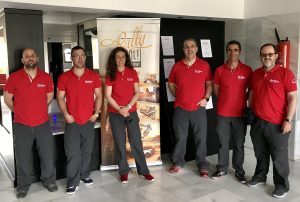
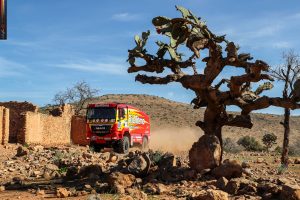 The Portuguese, who participate at the wheel of a MAN TGS, have as main objective for this competition the achievement of a place at the podium of the truck category. However, although they acknowledge that there are many difficulties in this race, especially the ones regarding to the routes that the organization of the competition presented, they believe that it is possible to fight for a good classification: “what impresses me the most in this race is not only the number of trucks that are present, but their level of preparation. Each of them is a showcase of the team’s ability to prepare. If the level of progress in the race is equivalent … this race promises to be quite disputed”, revealed Elisabete Jacinto.