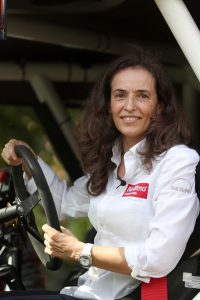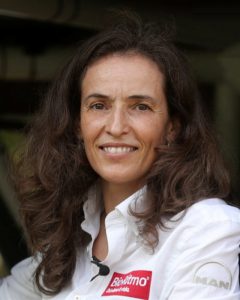
Interview with Elisabete Jacinto

Elisabete, please tell us how you came to the idea of riding a motorbike?
Once, Jorge and I were leafing through a motorcycle magazine at a kiosk in Lisbon and asked each other: «Why don’t we get a permit to ride motorbikes?» Why not? We did, and bought a Cagiva Elefantre 125. Therefore, our household got a car and a motorbike. Since Jorge had to wear a tie to go to work, he always took the car, and I took the motorbike … of course! So, it began as a simple way of travelling around town.
I became a member of Clube Todo-o-Terreno, just for fun, and their mailings about rallies started arriving at our home. There was a time when we decided to take part in «Ronda dos Castelos». And that was my first motocross!

How did it go?
Terrible! I didn’t know how to ride on earth and managed only eighty of the expected two hundred kilometres. I had several falls, the radiator opened and lost all the water, so I had to give up the ride. Jorge, who by then had a Honda Dominator, finished the ride alone, though with some difficulties. Our conclusion was that the problem consisted in the fact that the motorbikes were not the right ones for motocross. So we spent a year saving as much money as possible and bought two identical Kawasaki KDX.

How did you go from there to the motocross championship?
At this point, we started our weekend rides. We and a group of friends would go around the country. Until someone challenged me to enter a competition. I didn’t want to. I felt unable, lacking physical conditions … lacking technical skills! But they kept saying the same thing again and again and I started thinking: «Is it possible that they are right? Will I be able?» … and I went! The competition took place in Serra de Grândola and involved crossing several rivers. I fell in one of them and took some time to manage to get the motorbike back on its wheels. The motor was full of water and refused to work any more. However, when I had thought myself incapable of riding 70km, at the moment I had already ridden 270km and was on the brink of finishing the competition! I felt extremely happy, I had a real sense of victory. The sensation was exhilarating. I fell in love with races and motocross. I spent days thinking about it and making plans to get ready to enter the next competitions.
From then on, I have never stopped!

And then came the internationalization …
In 1992 I took part in the first race. Then, for several years, I entered the Campeonato Nacional de Todo-o-Terreno and won the Ladies Cup from 1993 to 1998. Then, one day, I decided to enter Spanish competitions. I remember being unable to sleep when I thought about the 650km of Baja de Aragon at 40ºC. I was afraid of failing to stand those conditions. I remember suffering terribly for the last 200km. All my body ached and the intake of air was not enough for my lungs! My heart went pit-a-pat … Upon arrival at servicing, I complained: «Jorge, I can’t stand any more!» And he answered: «Of course you can! You are doing very well!» I believed him and finished the competition!

And you never thought about giving up?
Of course I did! At every race I decided it was going to be the last … no come back. I remember having told Jorge, after finishing the first Baja de Aragon (in 1994): «If I ask you again to help me in entering anything like this … please say no! I don’t have the physical conditions for this sort of thing!» Ten minutes later, after eating and noticing that a big group of strong men I considered much tougher and better drivers than myself  … had stayed behind after all … I changed my mind: «Look … what I said just now … was not to be taken seriously! If I have a chance to come back … do help me!»

Does that mean that Jorge (your husband) was an important factor for you?!
Of course! If it weren’t for him, I would have taken part in two races and then quit. He was always behind my moves!
As a matter of fact, we were together in the two first races, with our twin motorcycles (Suzuki DR 350). Then we noticed we had no money for all that and one of us had to give up. Jorge decided it would be him because he thought it might be easier for me to get sponsors. So, we still shared the same hobby, but he moved to the background. This means he does all the work nobody knows about and therefore nobody takes into consideration but nonetheless is fundamental. In fact, it is thanks to that work that I have been able to finish races. Through all these years he has assumed every job: Team manager, engineer, assistant, responsible for logistics, adviser, masseur, PR … In short … everything I do not do … he does!

Then, how did you come about with the idea of going to the Dakar?
I remember thinking one day that it was time to stop riding motorbikes. Well … I wanted to have children and the biological clock doesn’t stop ticking! At the time, I regretted not having taken part in competitions in Africa. After all, I am a Geography teacher. I teach my pupils how dunes come about and I had never seen them … I figured myself racing in the desert and that made sense in my head. Soon after, I was watching Dakar on TV and thought: «I can ride a big, heavy motorcycle like this … I can ride for all those miles …» and I felt elated … The idea of going to the Dakar grew up in me in such a way that I started organizing it obsessively.
I was absolutely sure that I could do it and nothing made me stop.
For that year I planned the rally in Tunisia and the Atlas Rally to get some experience. For the rally in Tunisia I had to borrow money from a friend but for the Atlas rally I didn´t reach the necessary amount, so I did not go. For Dakar I tried everything I could, however, when it came to paying the last bills … I had no money. The solution was to ask a bank loan; three million Escudos I took four years to pay.

And was it worthwhile?
Of course it was. But that Dakar involved a lot of problems. There were aspects related to preparing the motorcycle which were faulty and problems arose from there. Every day my giving up was news on TV. Until one day I did have an electrical problem I was unable to solve and then I ascertained I had to give up for real. That was a very tough moment. One of the toughest I have ever experienced. I was sure I would never be able to take part in motorcycle races again, having to work all the time to pay my debt … therefore, my dream of «Dakar» was ruined and nobody would trust me ever again.

But after all you did come back!
Yes. That’s life. There are times when everything seems lost and it isn’t!
In fact, I went back the year after, sponsored by Trifen 200 and very well prepared. Everything was going well until, going through dunes made up of very soft sand, I broke the motor of the KTM. Once again, I was coming home earlier because of mechanical problems, so I kept sure I was a «Superwoman» and might get to the end of the Dakar.

That was in 1999, right? But then you tried again!
That year I learnt there are no «Supermen» in that race. Drivers form teams of 2 to help each other. Therefore, I got organized, reinforced the team and did the Dakar with another driver, Mário Brás. The race was spectacular and everything went well. I only lost some time once to help Mário, who was without petrol, and I had very good results in some specials. It was super. I not only finished the race, I also won the Ladies Cup. Everybody applauded. I felt very happy. It was a dream come true.

But that was not enough for you, and you decided to go back in 2001!?
You know, Dakar in 2000 was shorter in four days because there were terrorist threats. In spite of my outstanding achievement, people patted me on the back but kept saying: « … you were lucky Dakar this year was four days shorter! …» I swallowed and felt furious. I was sure they didn´t believe I would have finished the Dakar if it had had all the usual days. I myself started having doubts. Therefore, when Jorge suggested to put an end to our sports activities I was strongly against: «I want to go back! I want to make a full Dakar!» After discussing it vibrantly, we started the preparations for yet another try. I made a team with Pedro Machado and had a car to assist me. Everything was well organized. I took the best two mechanics in the country: Rui Pôrelo in the car and João Santos flying to the three stages it was possible to do so. I was very well prepared and stronger than ever …

But you had problems?
Yes! The luck factor failed!
The car to assist me stepped on a mine on the border between Morocco and Mauritania. The front of the car exploded and all the people inside had to be evacuated to a hospital in the Canary Islands. I was left alone, without a mechanic, without assistance, without anything … I only had the equipment I was wearing … I was sure I would have to give up once again! … That was the moment when I took a very strong decision: «I’ll give up the moment I fall and can’t get up again. Zé Ribeiro deserves my commitment and for him I’ll test my limits!»
That was the Dakar where I found out the limit is in fact in ourselves!
I fell a million times and I million times I got up and proceeded! I got to the end!
It was a Dakar full of suffering!
Even the course was very tough. Particularly slow, with plenty of dunes, rocks and grass … When we finished a streak, we had to do everything, for there was noone to help us: organize camping, care for the mechanical condition of the motorbikes, prepare navigation for next day … At the end of the day, we didn’t have many hours to sleep. There were nights when we slept for no more than four hours! It is not enough when you are riding a motorcycle! … the day after, I was too tired and fell even more, spent more time, finished later … rested less …
I finished with a lot of lesions, several broken bones … and when I reached the finishing line, having completed a whole Dakar, the toughest in recent years, and having done so without the necessary conditions … instead of joy I felt deeply sad!
My participation was very worthy, much more than in the previous year! … but I didn’t bring back a title … therefore nobody thought about it as valuable!

Was that the reason why you decided to stop motorcycle racing?
… I confess it was a kind of frustration that made me stop. I mean, to go back to Dakar, it would have to be to get a good result. Just to get to the end was no longer enough for me … and I didn’t manage to create the necessary conditions to get better results. I would have to train riding the motorcycle several times a week, and that would prevent me from going on with my work. Besides, I would need someone to train with, because you don’t progress by yourself. I was unable to get enough money to enter the races I considered adequate … and couldn’t get the money necessary to go back to the Dakar …
I was angry and said: «I’m not doing anything more!», at a time I thought I still had skills to develop!

Then you decided to race with trucks!?
Yes … you see, I didn’t feel the time had come for me to give up racing. I had learnt a lot over those years and I thought it was the right moment to put all that learning to good use.
Taking part in a Dakar with a motorbike was the toughest thing I had ever done. After such an experience, I felt I could dare anything. Why not racing with a truck?!

And why not with a car?
Don’t forget my problem consisted in getting the necessary financial conditions to be able to train and progress. I needed something brilliant enough to guarantee sponsors would have some return on their investments.

But you did take part in car races?!
For two years I entered the Copa Jimny and some world cup races, in a Toyota, but only as a transition from motorcycle to truck. It mustn’t be forgotten that for many years I only rode motorcycles and needed to get the perception of four wheels.

However, to get a license to drive trucks in October and going to the Dakar in January wasn’t a bit mad?
I agree … but carefully thought over!
I had to be sure I could drive a lorry in the toughest race in the world, but the first experience is always complicated. It is unlikely that everything goes well. So, I grabbed a chance and entered for the first time without investing too much. The truck I drove was very old and very heavy because it was full of stuff to assist other teams.
And then I learnt a lot, getting the notion that the Dakar was something I could achieve if I had a good truck and a good team. I even got the idea that I would be more competitive than with the motorbike.

After the first experience you returned with a Renault Kerax.
With the Renault Kerax we set in motion a very interesting project, we made an Iberian team. The truck and the team were Spanish. Trifene 200 and I, Portuguese.
I learnt everything with that truck. This means we started a sports project virtually from scratch in terms of knowledge. The challenge was simply to finish the Dakar with a truck. I did it and in the meantime i learnt how to race with a truck, I found out which were the weak and the strong points of this kind of vehicle, what is necessary for evolving it. I learnt how to manage weight matters and all the aspects of driving. Our main problem was that of suspensions. We suffered a lot of bounces and were unable to move fast. We worked a lot on this particular subject, and the truck was already with a good pace in the last Dakar (2006) I entered with it. We had achieved a good tuning and reliability.

And how is it to take part in races driving a truck?
A truck is a particularly difficult vehicle. Let us say it was not made to enter races, which complicates everything. We have to be perfectly aware of its capacities and limitations, and we must drive it with perfection. No mistakes may be made, because we pay dearly for them. But perfection is something we do really strive for when we are in competition. That is why this game of trying to drive better and better, and to obtain the best possible results, enthuses and gives me incentives.
Then there is the technical part of developing and preparing the vehicle too. At first we knew absolutely nothing about this subject. Now I am proud to say that several parts of our truck are made in Portugal, following our specifications, and have proved their quality. This is one of our greatest achievements.
But to take part in races with a truck also means to be able to work in a team. With a motorcycle the team was very small. To compete with a truck implied learning to be with other people in all sorts of situations. To coordinate and work in a team is one of the most difficult things to achieve. This was something i had to learn, and it turned out to be one of the most rewarding experiences sports gave me. At present I am proud to say I have an excellent team.

And what about the experience with MAN M2000?
Well … that was another important stage in my career. It was the time to show how skillful I had become. Having learnt with Renault Kerax, with man m2000 I wanted to prove what I could achieve. I loved driving that truck, which was a sort of toy. It was very well conceived, perfectly balanced, with quality in everything it could do, and it helped me to progress. For the Dakar 2008 (which did not take place) and 2009 I was already prepared to have good results, but luck was not on my side. I had to give up at the fifth streak of the latter rally.

Why?
Because inside one of the many dust clouds, where sight was completely obliterated, I crashed into the rear of Ivan Muller’s buggy, which had stopped on the track. He had slowed down because he too had been unable to see, and then he could not move. Due to the characteristics of the terrain, we all had to race on the same track, where deep ruts formed. I bumped into the buggy, but only managed to see its features when I tried to revert for the second time, and then it was already aflame. The lorry stuck to the rear of the buggy, and we were unable to free it. The three hundred liters of petrol the buggy carried did not give any chance to our fire extinguishers.

Now you are about to start a new phase in your sports life, since you are going to use a new truck for the first time: man TGS. What has been your experience with it so far?
It is still racing with a truck out of the production line, but this time the engine e stronger, therefore with more power and more exacting when driving. However, its bigger cylinder capacity allows me to drive much faster and to reach very good results. At present i am a candidate to a podium position in every race I enter. We have been intent on improving several technical aspects, rendering it more competitive. For example, we made it lighter, with a new cargo box, managing to get a weight slightly inferior to ten tons. We invested in shock absorbers, but there is still room for improvement at that level. We built brackets for the steering shock absorbers and simultaneously adapted a competition steering axle. We sent the engine to Germany and now we have 830 hp to help us climbing sand slopes and progressing on the soft sand ergs of Mauritania.

We understand the team has changed a lot at image level. What do you think of this change?
I consider this new brand, which is the image of the all team, means our work and our goals are strong. Let us say that the new brand is Bio-Ritmo, a food supply to help give more energy to those who need it, therefore contributing to lessen the physical and intellectual tiredness. Red is in itself a strong color, transmitting strength and energy, and that is precisely our state of mind at present. As it appears now, man has a very strong presence… and this is important when we wish to make a stand.
We are a strong team, full of determination… but our resources are limited, therefore we have moments of tiredness and exhaustion. In spite of all that, and as Bio-Ritmo, we do not break and are determined to be always better and fight for victory.

Elisabete, after so many years racing, there is an inescapable question: “what keeps you still doing it?”
Enjoying going to the limit and then more. The fact that I feel to be doing things I was incapable of doing in the past.
Practicing sports has been very good for me. I am stronger, feel more sure of myself, am capable of more … have a vision of the world more adapted to the reality!
I enjoy the certainty that we can go wherever we want to, that limits are within ourselves … and the key to success is “willpower!”

Elisabete Jacinto
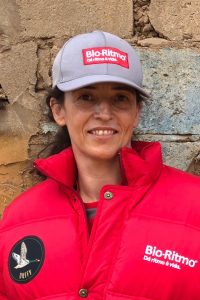
The most radical woman adventurer

Elisabete Jacinto challenged a men’s world for several years while taking part in the most difficult motocross competitions for motorbikes all over the world. However, for this geography teacher who only at 24 learnt how to ride a two wheel vehicle (and planning nothing more than to use it in everyday life) her main challenge has always been herself, since she believes will-power and tenacity are enough to remove all barriers.

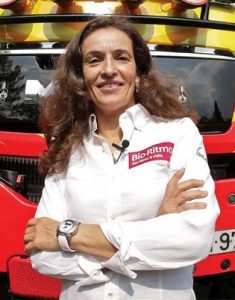
And that was her motto to overcome every difficulty and not only becoming the first Portuguese woman to dare facing the mythical Paris Dakar on a motorcycle but also heroically reaching the end of the race and, above all, being the first among women, when some of these had enormous feats in their résumés and were part of professional teams.

Motorcycles were succeeded by cars and again she won international competitions among women.

However, great challenges are still welcome by Elisabete Jacinto’s internationally recognized tenacity and, three months after obtaining her driving license for trucks, she was at the starting point for the 25th edition of Dakar (2003) driving a lorry, the sort of vehicle which has a fantastic competitive space in the African rally but from which women kept away for many years.

Then, in 2004, Elisabete becomes not only one of the first women to finish the Paris-Dakar rally at the steering wheel of a lorry but also the first woman to actually winning a special interim classification in the category during Rallye Optic Tunisie 2000.

Since then she has been permanently working to progress at the levels of driving, technically preparing her truck and organizing a team of which she is very proud. About 40% of her truck’s technical preparation is at present made in Portugal.

Though her experience in competitions has also had several particularly difficult moments, Elisabete does not throw the towel and she proceeds to the top in general classification at all the different races she enters.

2004 History

tira_historial_2004

Elisabete enters the Paris-Dakar Rally for the second time with a truck – a Renault Kerax 4×4.

When she finished this rally (in 26th place) she became one of the first women in the World to have managed to do so.

Her success motivates her to take part in other World Cup competitions. One of these is the Rallye Optic Tunisie, and she becomes the first woman in the World to win a special streak driving a truck.

She finishes this rally as runner-up in the truck category.

In spite of the success, Elisabete and Renault Trucks decide to cut the sports season short in order to make mechanical improvements in the truck, particularly at suspensions and engine levels.

Following an invitation by Alberto Gonçalves, she enters Rallye Aicha des Gazelles for the second time with Sofia Carvalhosa in a Renault Kangoo.

Elisabete’s aim was to win in the SUV category, but a penalty wrongly imposed by the organization classifies her as runner-up.


Elisabete Jacinto

beta_01A mais radical das aventureiras
Durante vários anos Elisabete Jacinto desafiou o universo masculino, competindo em moto nas mais difíceis competições de todo-o-terreno, disputadas em diversos continentes. Todavia, para esta professora de Geografia que apenas aos 24 anos de idade aprendeu a pilotar uma máquina de duas rodas e apenas com o intuito de dela se servir para o dia-a-dia, o maior desafio foi sempre consigo própria, acreditando que a vontade e tenacidade superam todas as barreiras.

E foi sob esse lema que, passando por cima de todas as dificuldades, não só se atreveu a ser a primeira portuguesa a enfrentar o mítico Paris-Dakar em moto, acrescentando-lhe a proeza de concluir a prova mas, mais do que isso, conseguindo triunfar entre as Senhoras, contra adversárias detentoras de um enorme palmarés e integradas em equipas profissionais.

Às motos, sucederam-se os carros e o retomar das vitórias internacionais entre as Senhoras.
Mas os grandes desafios continuam a encontrar eco na tenacidade internacionalmente reconhecida de Elisabete Jacinto e, três meses depois de ter obtido a carta de condução de pesados, apresentou-se à partida, para a edição das bodas de prata do Dakar (2003), instalada aos comandos de um Camião, um tipo de máquina que encontra na prova africana uma magnífico espaço para competição, mas da qual as mulheres se mantiveram afastadas durante largos anos.

É em 2004 que Elisabete não só se torna numa das primeiras mulheres do Mundo a concluir o rali Paris-Dakar conduzindo um camião como se transforma na primeira mulher a ganhar uma especial nesta categoria no Rallye Optic Tunisie 2000.

Desde então tem levado a cabo um trabalho contínuo tendo feito progressos ao nível da condução, preparação técnica do seu camião e organização de equipa do qual muito se orgulha. Cerca de 40% da preparação técnica do seu camião é, actualmente, feita em Portugal.

Apesar da sua experiência na competição ter sido também marcada por alguns momentos particularmente difíceis, Elisabete não baixa os braços e ruma em direcção ao topo da classificação geral das mais variadas competições onde participa.

Elisabete Jacinto – Cross-Country Driver

beta_curriculumElisabete Jacinto
Date of birth: 8th June 1964
Marital Status: Married
Place of birth: Montijo
Living in: Lisbon/Benfica

Studies:

Graduated in Geography at Faculdade de Letras, Universidade de Lisboa in 1987.
Post-graduation in Geography Teaching.

Jobs:

Geography teacher (not exercised at present).
Cross-country driver.

AUTHOR OF SCHOOL BOOKS:

“Guia de Aprendizagem de Geografia” (Volumes I and II) for the subject of Ciências Sociais e Formação Cívica studied at Evening School. Written with co-author Eduarda Pina (1995). Published by Plátano Editora.

“Guia de Aprendizagem de Ciências do Ambiente, Unidade 3 – A Terra em Transformação”, for Basic School pupils with learning difficulties (1996). Co-author Maria Eduarda Pina. Published by Plátano Editora.

“Guia de Aprendizagem de Ciências do Ambiente, Unidade 6 – A Terra em Movimento”, for Basic School pupils with learning difficulties (1996). Co-author Maria Eduarda Pina. Published by Plátano Editora.

“Guia de Aprendizagem de Ciências do Ambiente, Unidade 8 – Elementos Climáticos e Factores que os Condicionam”, for Basic School pupils with learning difficulties (1997). Co-author Maria Eduarda Pina. Published by Plátano Editora.

“Guia de Aprendizagem de Ciências do Ambiente, Unidade 9 – O Clima como factor do Ambiente”, for Basic School pupils with learning difficulties (1997). Co-author Maria Eduarda Pina. Published by Plátano Editora.”Ciências Sociais e Formação Cívica – Guia de Aprendizagem”, Units 5, 6, 7 and 8. Co-authors Margarida Sequeira, Maria Adelaide Soares and Maria Eduarda Pina (1998). Published by Plátano Editora.

“Ciências Sociais e Formação Cívica – Guia de Aprendizagem”, Units 9, 10, 11 and 12. Co-authors Margarida Sequeira, Maria Adelaide Soares and Maria Eduarda Pina (1998). Published by Plátano Editora.

AUTHOR OF COMIC STRIP BOOKS

“Os Portugas no Dakar” (Portugeese at the Dakar), Volume 1, co-author Luís Pinto Coelho, published by Plátano Editora, 2003.

“Os Portugas no Dakar” (Portugeese at the Dakar), Volume 2, co-author Luís Pinto Coelho, published by Plátano Editora, 2007.

“Irina no Master Rali” (Irina at the Master Rally), Plátano Editora, 2010

LECTURER

She deals with subjects connected with her sports activity in schools, universities and firms.

DECORATIONS and DISTINCTIONS

Ordem do Mérito (Order of Merit) – Granted by His Excellency the President of the Republic

Diploma de Mérito Desportivo (Diploma of Merit in Sports) – Federação Nacional de Motociclismo (National Federation of Motorcycling)

Diploma de Mérito de Barca da Aldegalega (Diploma of Merit from Barca da Aldegalega) – Junta de Freguesia do Montijo (Small Constituency in Montijo)

Diploma de reconhecimento por serviços prestados (Diploma recognizing relevant services) – Região de Turismo da Costa Azul (Blue Coast Tourist Region)

“Prestígio” (Prestige) Prize – Federação Portuguesa de Automobilismo e Karting (Portuguese Federation of Car Racing and Karting)

Distinguished by the President of the Portuguese Republic, Professor Anibal Cavaco Silva in the Celebration of the 10th of June in 2014.

Reception by the President of the Portuguese Republic, Professor Marcelo Rebelo de Sousa, 2019

Montijo County Gold Medal, 2019

SPORTS RÉSUMÉ IN MOTORCYCLES

TITLES

1993, 1994, 1995, 1996, 1997, 1998
Winner of the Ladies’ Trophy in the National Motocross Championship

1999, 2000, 2001
1st Woman in the Motocross World Cup

INTERNATIONAL RACES

1994

Winner of the Ladies’ Cup in Baja de Alta Alcarria (Spain)

Winner of the Ladies’ Cup in Baja de Aragón (Spain)

1995
Winner of the Ladies’ Cup in Baja de Alta Alcarria (Spain)

1996
Winner of the Ladies’ Cup in Baja de Alta Alcarria (Spain)

1997
Baja de Alta Alcarria (Spain):

1st in the Ladies’ Cup
5th in Class 4
13th in General Classification

Baja España Aragón (Spain):

1st in the Ladies’ Cup
3rd in the less than 400cc Class
13th in General Classification

Received a merit in sports distinction

Rallye Optic Tunisie (Tunisia):

Runner-up lady
2nd in the less than 400cc Marathon Class
52nd in General Classification

1998
Rallye Paris Granada Dakar:
Took Part

Rallye Optic Tunisie (Tunisia):Runner-up lady
1st in the 250cc Class
60th in General Classification

Rallye Atlas Savane (Morocco):
Runner-up lady
3rd in the up to 250cc Class
47th in General Classification

Rallye Alta Alcarria (Spain):
1st in the Ladies’ Cup
3rd in the up to 250cc Class
13th in General Classification

Baja Aragón (Spain):
1st in the Ladies’ Cup
6th in the up to 250cc Class
15th in General Classification

Montes de Cuenca (Spain):
1st in the Ladies’ Cup
35th in General Classification

UAE Desert Challenge (United Arab Emirates):
67th in the General Classification

1999
Rallye Granada Dakar:
Took Part

Tunisian Rally:
3rd in the Ladies’ Cup
64th in General Classification

Master Rally:
1st in the Ladies’ Cup
8th in General Classification

Baja Telecel 1000:
1st in the Ladies’ Cup

Montes de Cuenca (Spain):
1st in the Ladies’ Cup
8th in General Classification

UAE Desert Challenge (United Arab Emirates):
Took Part
World Cup Classification:
1st Among Ladies
13th in General Classification

2000
Rallye Dakar Cairo:
1st in the Ladies’ Cup
49th in General Classification

Tunisian Rally:
Took Part

“Trophée Optic 2000 de L’Exploit”

Master Rally:
Took Part

UAE Desert Challenge (United Arab Emirates):
1st in the Ladies’ Cup
8th in General Classification

World Cup Classification:
1st Among Ladies
25th in General Classification

2001
Rallye Paris Dakar:
Runner-up in the Ladies’ Cup
56th in General Classification

Montes de Cuenca (Spain):
1st in the Ladies’ Cup
9th in General Classification
Baja Aragón (Spain):
1st in the Ladies’ Cup
13th in General Classification
UAE Desert Challenge (United Arab Emirates):
1st in the Ladies’ Cup
4th in General Classification

World Cup Classification:
1st Among Ladies
13th in General Classification
2000
1st Woman in the Motocross World Cup

SPORTS RÉSUMÉ IN CARS

2000
Baja TT Optiroc:
Took Part

2001
3 Hours CC Compaq:
Runner-up in Jimny Cup
1st Ladies Team

Baja Telecel 1000:
16th in Jimny Cup
1st Ladies Team


24 Hours CC Vodafone
:
16th in Jimny Cup
23rd in General Classification

2002
3 Hours CC Accenture:
10th in Jimny Cup
30th in General Classification


Lameirinho / Serras do Norte CC Rally
:
12th in Jimny Cup
32nd in General Classification

Baja España Aragón:
Runner-up in the Ladies’ Cup (driving a Toyota Land Cruiser/T2)
16th in T2 rank
42nd in General Classification
Esporão Vindimas CC Rally:
6th in Jimny Cup

Master Rally:
1st in the Ladies’ Cup (driving a Toyota Land Cruiser/T2)
6th in T2 rank
23rd in General Classification

2003
Rallye Aïcha des Gazelles:
Winner in SUV rank (driving a Renault Kangoo)

2004
Rallye Aïcha des Gazelles:
Runner-up in SUV rank (driving a Renault Kangoo)

2006
Orpi Morocco Rally:
Took Part (driving a Bowler Wildcat)

SPORTS RÉSUMÉ IN TRUCKS

2003
Telefónica Dakar Rally:
Took Part (driving a Mercedes)

2004
Telefónica Dakar Rally:
26th in General Classification (driving a Renault Kerax)

Rallye Optic 2000 Tunisie:
Runner-up in General Classification (driving a Renault Kerax)
(1st in General Classification at the 5th round)

2005
Telefónica Dakar Rally:
24th in General Classification (driving a Renault Kerax)
Rallye Orpi Marroc:
3rd in General Classification (driving a Renault Kerax)
AMV Shamrock Rally:
1st in General Classification (driving a Renault Kerax)

2006
Lisboa-Dakar Rally:
Took Part (driving a Renault Kerax)

AMV Shamrock Rally:
Took Part (driving a MAN M2000)

2007
Lisboa-Dakar Rally:
21st in General Classification (driving a MAN M2000)
7th in the Trucks with Less than 10 000cc class

Optic 2000 Tunisie Rally:
2nd in General Classification (driving a MAN M2000)

AMV Shamrock Rally:
1st in General Classification (driving a MAN M2000)

2008
Rallye Aïcha de Gazelles (Morocco):
2nd in General Classification (driving a MAN M2000)

Tunisian Rally:
2nd in General Classification  (driving a MAN M2000)
1st in the Trucks With Less than 10 cc Class

AMV Shamrock (Morocco):
Took Part (driving a MAN M2000)

2009
Dakar-Argentina-Chile Rally:
Took Part (driving a MAN M2000)

Shamrock Rally (Morocco):
2nd in General Classification (driving a MAN TGS)

2010
Africa Race Rally:
Took Part (driving a MAN TGS)

Tunisian Rally:
1st in the General Classification of Trucks (driving a MAN TGS)
8th in the General Car/Truck Classification

Moroccan Rally:
1st in the General Classification of Trucks (driving a MAN TGS)
11th in the General Car/Truck Classification

2011
Africa Eco Race Rally
:
2nd in the General Classification of Trucks (driving a MAN TGS)
7th in the General Car/Truck Classification

Tunisian Rally:
1st in the General Classification of Trucks (driving a MAN TGS)
8th in the General Car/Truck Classification

2012
Africa Eco Race Rally:
2nd in the General Classification of Trucks (driving a MAN TGS)
4th in the General Car/Truck Classification

Aïcha Des Gazelles Rally:
3rd in the General Classification (driving a VW Amarok)

Baja de Aragón:
2nd in the General Classification of Trucks (driving a MAN TGS)

Moroccan Rally:
3rd in the General Classification of Trucks (driving a MAN TGS)
13th in the General Car/Truck Classification

2013
Africa Eco Race Rally:
3rd in the General Classification of Trucks (driving a MAN TGS)
7th in the General Car/Truck Classification

Aïcha Des Gazelles Rally:
11th in the General Classification of Car/Trucks (driving a VW Amarok)

Baja de Aragón:
2nd in the General Classification of Trucks (driving a MAN TGS)

Moroccan Rally:
1st in the General Classification of Trucks (driving a MAN TGS)
17th in the General Car/Truck Open Classification

2014
Africa Eco Race Rally:
3rd in the General Classification of Trucks (driving a MAN TGS)
7th in the General Car/Truck Classification

Rali Aïcha des Gazelles:
2nd in the General Classification of Car/Trucks (driving a VW Amarok)

Moroccan Rally:
4th in the General Classification of Trucks (driving a MAN TGS)
10th in the General Car/Truck Open Classification

2015
Africa Eco Race Rally:
4th in the General Classification of Trucks (driving a MAN TGS)
11th in the General Car/Truck Classification

Rali Aïcha des Gazelles:
6th in the General Classification of Expert Class (driving a VW Amarok)

Moroccan Rally:
12th in the General Classification of Trucks (driving a MAN TGS)
24th in the General Car/Truck Open Classification

 2016
Africa Eco Race Rally:
3rd in the General Classification of Trucks (driving a MAN TGS)
14th in the General Car/Truck Classification

Rali Aïcha des Gazelles:
5th in the General Classification of Expert Class (driving a VW Amarok)

Libya Rally:
Took Part

2017
Africa Eco Race Rally
Took Part in the

Morocco Desert Challenge Rally:
3rd Place in the Truck Class Classification

Oilibya du Maroc Rally:
Took Part

2018
Africa Eco Race Rally
Took Part in the

Morocco Desert Challenge Rally:
7rd Place in the Truck Class Classification

2019
Africa Eco Race Rally:
1st place in the Truck General Classification (driving a MAN TGS),
5th place in the Car/Truck General

HOBBIES:

Recreational Diving:
Master Scuba Diver, PADI, 2009
Divemaster, PADI, 2010

Photography

EXPERIENCES:

Parachuting Course
Blue Emotion Parachuting School, 2007

Mountaineering
Climbing Mont Blanc with success, in an activity promoted by the French Government when it assumed the European Union Government. 2008.

2013 History

tira_historial_2013

As in the previous season, Elisabete Jacinto takes part in competitions with the MAN TGS truck, and the navigator is José Marques, and the mechanic, Marco Cochinho.

The season began with the Africa Eco Race Rally, where there were rather competitive trucks. The team got third place among trucks and was seventh in the Car/Truck joint classification.

Once again, they entered Baja de Aragón, where they managed to be second in the truck category, and they finished the season with a brilliant first place among several prototype trucks in the Oilibya du Maroc Rally.

During the season there were training sessions in Morocco, bearing in mind the continuous technical improvement of the MAN TGS.

Elisabete also took part in the Rallye Aicha des Gazelles, driving an Amarock, once again in the VW France Team, and having the French woman Valérie Dot as navigator.

They led the competition from the first day but, when there were only thirty kilometers to the finishing line, a mechanical problem made them lose places, and they were eleventh.


2012 History

tira_historial_2012

Having finished the Africa Eco Race with an excellent second place among trucks and fourth in the Car/Truck classification, the team felt the need to technically improve the truck.

Therefore, the performance of the engine was enhanced, the tanks were raised to better allow going over the crests of dunes, a cabin support system was created, and the exit angle and suspensions were improved.

The truck also changed in appearance, with the new logo of the Oleoban brand.

Instead of the usual Tunisian rally (which did not take place this year),  the team entered the Baja de Aragón and is second among trucks and seventh in the Car/Truck general classification. There followed the Moroccan rally, where once again they had to face really competitive trucks, and they finished in third place.

The year 2012 also included Elisabete taking part in the main navigation rally in the world, the Aϊcha des Gazelles Rally. She was invited to enter the Volkswagen team, which had 10 Pick-up Amarock in it. She teamed with Sofia Carvalhosa and was third in the Car/Truck classification.

It was a good sports year for the whole team!


2014 History

tira_historial_2014

The year 2014 began with the Oleoban team entering the Africa Eco Race Rally.

At the last streak Elisabete drops from second to third place in the Truck category due to a problem in the front transmission of her MAN, driving the last 60km with just two-wheel drive.

With Valérie Dot she takes part in the Aicha des Gazelles Rally, driving a VW Amarock, and finishes second in the 4×4/Truck category.

In the Moroccan Rally she competes with several prototype trucks and finishes fourth in the Truck category. This year, Hydraplan, Lisbon MAN concessionary, moved to another venue, and that reflected in the need for a new workshop.

A new cargo box, more functional and resistant, was built for the assistance truck.

The competition truck also had its cargo box replaced with a lighter one and having better aerodynamic performance.

2011 History

tira_historial_2011

The 2011 sports season begins with Africa Eco Race.

Happy to go back to the big African marathon, the team gets to the end of this rally for the first time, being second among trucks and seventh in the car/truck joint classification.

The beginning of 2011 was a time of distress, with revolution in many North African countries.

The Tunisian rally was in danger of not taking place but, to give a sort of affidavit to the newly formed democracy, both the organization and the teams made an effort to be present.

The rally was held as normally as possible.

The result obtained by the MAN TGS was first place among trucks and eighth in the car/truck classification.

At the Moroccan rally the team had to deal with a vast number of prototype trucks and strong competition. It held its own with teamDeRooy and finished in third place, first among regular trucks.

At the end of the year Elisabete decides to change the configuration of the suspension buffer springs, in order to become more competitive. She asks ELO to produce buffer springs capable of improving the suspension in her truck, and she starts preparing for the next season.


2010 History

tira_historial_2010

The team starts the 2010 season with Africa Race.

Although her performance is excellent and she is very happy to return to the great African marathon, Elisabete has to quit due to mechanical problems.

The first part of the year is then dedicated to make the truck reliable and to adapt it for competition.

Elisabete enters the Tunisian rally with one of the best truck navigators in the World, Charly Gotlib, and her sports results become noticeable.

She wins in the truck category and gets eighth place among cars.

At the Moroccan rally Elisabete confirms her good level and the excellent work of her team, winning again among trucks and being within the first eleven cars.